
August 27, 2026 in Advisory Notes
Building Preparedness for Climate-Induced Air-Quality H...
External air quality degradation has emerged as a major operational concern for Australian buildings and the issue is expected to intensify as the cli...
February 21, 2022
Since the phase-out of chlorofluorocarbons (CFCs) and hydrochlorofluorocarbons (HCFCs) the most common type of refrigerant available in the market today are hydrofluorocarbons (HFCs).
HFCs are synthetic, manufactured refrigerants, that were widely implemented predominantly due to their inability to break down and deplete the ozone layer (also known as having Zero Ozone Depletion Potential – ODP). HFCs are beneficial due to their efficient heat transfer properties, whilst being both inert and non-toxic.
The major problem with HFCs arise from their global warming potential (GWP). GWP is a physical property of greenhouse gases which indicates the propensity of the gas to trap atmospheric heat.
The Montreal Protocol on Substances that Deplete the Ozone Layer is an international agreement made in 1987. It was designed to stop the production and import of ozone-depleting substances and reduce their concentration in the atmosphere to help protect the earth’s ozone layer. The global HFC phase-down under the Montreal Protocol was agreed in 2016 in Kigali. This amendment will phase-down their product and imports of HFCs by 85% between 2019 and 2036.
In response to this, the Australian Government has initiated a “HFC Phase-down”, in line with many developed nations in the world. The HFC Phase-down is a gradual reduction in the maximum amount of HFCs permitted to be imported into Australia.
The structure of the Australian Government HFC Phase-down is geared towards limiting the importation of HFC gases, with a view of encouraging market forces to determine the best solution. As such, it is useful to observe the market to see what changes, trends and innovations are taking place.
Awareness of the issues with HFCs preceded the implementation of the government phase-down in 2018. HVAC equipment manufacturers, especially those with a global presence, had been working on developing equipment that functions on alternative refrigerants for some time.
Currently, the alternatives can be split broadly into three separate chemical groups. They are:
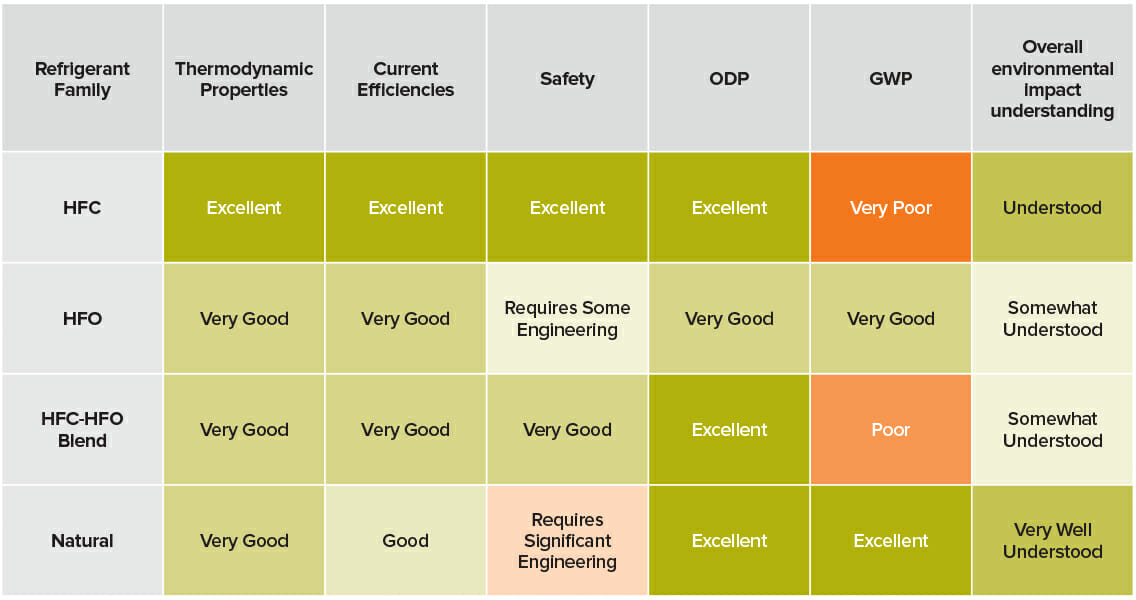
Natural Refrigerants – These are refrigerants with simple chemical composition, such as Ammonia (NH3) and carbon dioxide (CO2). These refrigerants are typically not as easy to use and require significantly more engineering in the machinery. Despite this, these compounds are generally very well understood due to their abundance in usage throughout history. Furthermore, both substances have 0 ODP, and a GWP of 0 and 1 respectively.
A broad comparison of the different families of refrigerants is displayed in the table below.
When reviewing refrigerants, it is also important to understand their safety classification, and in particular, their flammability. ISO established a system for assigning safety classifications and is adopted in AS/NZA 5149.
Current refrigerant trends with regard to chillers available in the Australian market are outlined as follows:

With the phase-down of HFC refrigerants, there will be reduced supply, and this is likely to result in increasing cost of the gas over time. This has been observed with an increasing cost of R134a over the past 5 years.
In common with the previous refrigerant phase-outs, the following actions are recommended to pre-empt and prepare for this issue:
It should be noted that the Kigali agreement is a phase-down and not a phase-out, meaning there are no HFC production bans as there were with like there was with hydrochlorofluorocarbons (HCFCs) such as R22; however, it is still important to consider the selection of the refrigerants in any new and replacement plant.
It is also important to understand that as the demand for HFO refrigerants grow, the list of approved HFC substitutes will likewise expand and better alternatives will enter into the market, whilst at the same time the new HFO machines’ pricing will become more competitive.
For more information about Refrigerant Management contact Jamie Park, A.G. Coombs Advisory, Tel: +61 3 9248 2700, Email: jpark@agcoombs.com.au


August 27, 2026 in Advisory Notes
External air quality degradation has emerged as a major operational concern for Australian buildings and the issue is expected to intensify as the cli...

July 20, 2026 in Advisory Notes
Building Management and Control Systems (BMCS) underpin the reliable and safe operation of commercial and institutional buildings. The technology cont...
May 26, 2026 in Advisory Notes
Australian Standard AS/NZS 4836:2023 was developed in response to identified risks to workers from electric shock and arc flash. It provides guidance ...
April 22, 2026 in Advisory Notes
As commercial buildings progress electrification programs, understanding how existing heating systems perform at lower operating temperatures has bec...