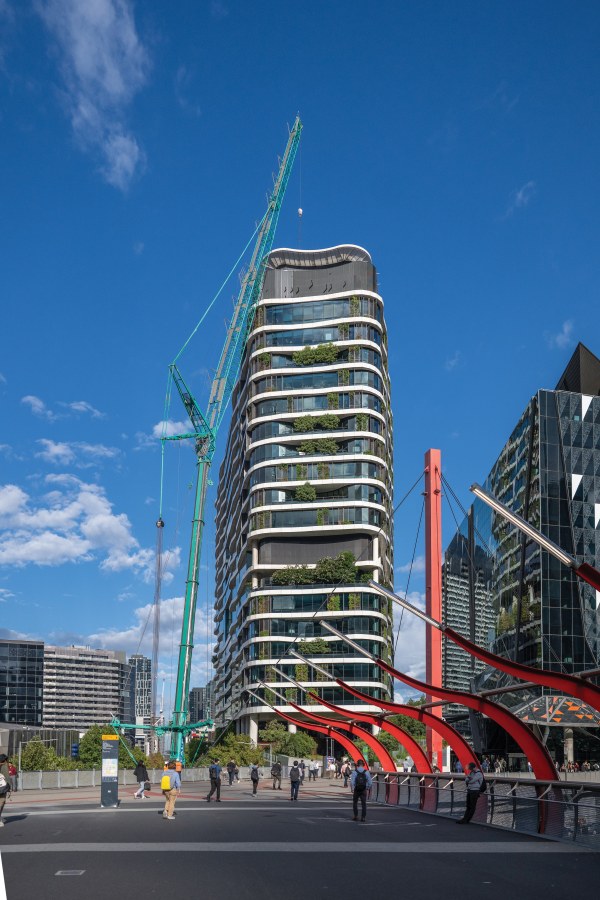
Previously occupied by Medibank, the building will be the new home for a large corporate tenant. The transition between two large-scale occupiers provided the opportunity for one of the nation’s largest commercial building electrification projects, transforming the property into an all-electric building powered by 100% renewable energy. A.G. Coombs was engaged by Cbus Property, with MRS Property as independent project manager to carry out the electrification works. The brief was as ambitious as it was unambiguous: remove the three gas boilers and install a fully electric, future-ready heating plant of equal thermal output, and with no tenant disruption.
Smarter path to electrification
The original design specified 14 new air-source heat pumps and six new water-source heat pumps with a total heating capacity of 3,360 kW, which would require a significant electrical supply upgrade for the added electrical load. A.G. Coombs offered a re-engineered hybrid alternative: eight Trane heat pumps; four air-source on the level 18 roof and four water-source in the adjoining plant room, delivering the same heating hot water thermal output and within the capacity of the existing electrical supply.
“The Trane platform gave us direct control over the power draw of each unit, so aggregate demand at peak capacity stayed within the electrical supply submains’ design rating,” says Mitchell Ryan, Engineer at A.G. Coombs. “This design removed the need for electrical supply cable replacements, switchboard upgrades and the associated project complexity and additional capital cost.”
The change will also deliver improved system operability. The air-source and water-source units operate in a cascade arrangement; the air-source units lift the cooled heating water returning from the water-source units to an intermediate temperature, and the water-source units Heat Pumps Explained take it through to the 75°C temperature required by the heating system. With all elements of the cascade from a single manufacturer and sequenced through the building management and control system (BMCS), the result is seamless operation.
Both the air-source and water-source heat pump units operate on next generation low global warming potential (GWP) refrigerant blends ahead of the government phase-down schedule for higher GWP refrigerants now reshaping the refrigeration industry.
To mitigate any refrigerant leakage, the new plant is equipped with refrigerant leak detection systems that meet the requirements of Australian Standard AS/NZS 5149 Refrigerating systems and heat pumps – Safety and environmental requirements.
Heat Pumps Explained
Heat pumps transfer existing thermal energy rather than generating it. Air-source heat pumps absorb energy from or reject to ambient outside air to heat or cool water to condition indoor spaces. Water-source heat pumps rely on the stable temperature of a piped water system to heat or cool water to condition indoor spaces. Air-source and water-source heat pumps have different operating and performance characteristics.
Crane day in Docklands
The crane lift for the new plant presented the single largest installation challenge. A 500-tonne crane with an extended boom was needed to lift the new equipment onto level 18, and the three-day permit window had to coincide with suitable weather in a notoriously windy precinct.
“Docklands offers very narrow program windows for crane lifts of that scale. Typically, only one day in five aligns with suitable weather, traffic conditions and site access,” reflects Darren Hill, Project Manager at A.G. Coombs. “Our three-day permit opened on 23 March 2026, and the team, working with MRS and Knight Frank as the Facility Manager, completed the road closures, tenant access and the lift itself on schedule.