Walker Fire Protection introduced the Green Fire concept more than 20 years ago, applying environmentally sustainable principles across the lifecycle of fire protection systems. Green Fire 2.0 builds on those principles, addressing both the environmental impact of fire protection and the role effective systems play in protecting facilities, resources and embodied carbon.
Today, the sustainability landscape has broadened considerably. Net zero emissions, embodied carbon, circular economy principles, electrification and building resilience are increasingly influencing how facilities are operated and renewed. At the same time, electric vehicles (EVs), battery energy storage systems (BESS), photovoltaics and alternative construction materials are changing the fire risk profile of the built environment.
FLEXIBILITY | ADAPTABILITY | DURABILITY | MAINTAINABILITY
This Advisory Note introduces Green Fire 2.0 and considers the relationship between sustainable fire protection and facility resilience.
Fire Resilience is Fundamental to Sustainability
A significant fire can result in the loss of building materials, equipment and contents, waste sent to landfill, the consumption and contamination of firefighting water, business interruption and, ultimately, the manufacture, transport and installation of replacement materials.
Research undertaken by FM Global and the Home Fire Sprinkler Coalition has demonstrated that effective sprinkler protection can significantly reduce fire damage, greenhouse gas emissions, firefighting water consumption and contaminated water runoff.
This highlights an important Green Fire 2.0 principle: sustainability should consider not only the environmental footprint of fire protection, but also the resources and embodied carbon that effective fire protection helps preserve.
The Facility Manager’s Sphere of Influence
Facility managers have considerable influence over these outcomes through the way fire protection systems are operated, tested, maintained, modified and renewed.
1. Conserve Water
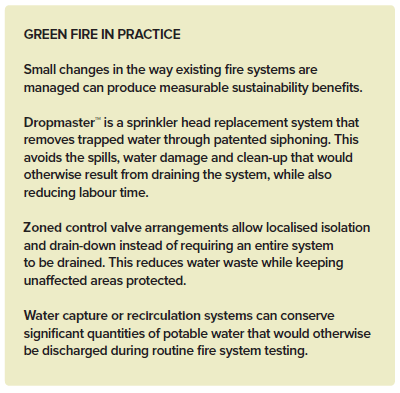
Fire sprinkler and hydrant systems can discharge significant quantities of potable water through routine testing, maintenance and modifications.
Water capture or recirculation, localised isolation, appropriate control valve arrangements and technologies that minimise sprinkler system drain-down can substantially reduce water consumption. Localised isolation can also reduce the extent and duration of system impairment, keeping unaffected areas protected while works are undertaken.
2. Keep Assets in Use for Longer
Circular economy principles are highly relevant to fire protection.
Where equipment and infrastructure remain suitable, compliant and capable of performing their required function, consider maintaining, repairing, refurbishing or retaining them rather than automatically replacing them.
This applies to individual equipment as well as existing pipework, cabling, detection systems, pumps and other infrastructure during refurbishment and tenancy works.
Procurement decisions should consider a facility’s “whole-of-life and environmental impacts,” not simply the lowest immediate replacement cost.
3. Reduce Carbon and Material Impacts
Manufacturing, transportation, installation, operation, maintenance, replacement and disposal all contribute to the lifecycle carbon impact of fire protection assets. Associated emissions that may fall within an organisation’s Scope 1, Scope 2 or Scope 3 emissions.
Retaining serviceable infrastructure, extending equipment life, reducing unnecessary modifications, selecting durable products and using remote monitoring where appropriate can reduce these impacts.
Importantly, these impacts should be considered against the potentially much greater carbon and material consequences of rebuilding following a major fire.
4. Design Today’s Changes for Tomorrow
Facilities continually change through tenancy alterations, refurbishments, technology upgrades and changes in use.
Appropriate zoning and control valves, flexible sprinkler arrangements, accessible isolation points and provision for foreseeable future changes can reduce material use, water loss, system impairment and rework over the life of the facility.
Design today’s fire protection solution so that it does not unnecessarily create tomorrow’s waste.