April 1, 2026 in News
Making Electrical Waves – Presbyterian Ladies’ Coll...
When the founders of the Presbyterian Ladies’ College (PLC) welcomed the first cohort of 60 students to their East Melbourne school in 1875, they co...
February 11, 2026
Standing 39 storeys tall in the inner-Sydney suburb of Haymarket, and adjacent to Central Station’s Platform 1, the 1.4 billion Atlassian Central development, owned by Dexus and Atlassian, demanded mechanical solutions as innovative as the company that will call it home. A.G. Coombs, engaged through the Built-Obayashi joint venture (BOJV) has been developing advanced mechanical solutions for the project since involvement in the ECI (Early Contractor Involvement) phase in 2020.
The mechanical services engineering brief is extraordinary: To achieve some of the most ambitious energy targets ever set for an Australian commercial building while delivering superior indoor air quality and thermal comfort. The building is targeting a 5.5-star NABERS Energy rating; 6-star Green Star certification; WELL and LEED ratings; the use of 100% renewable power; and 50% less embodied carbon (compared to a conventionally-constructed tower).
These ambitious sustainability targets need to be balanced with a 100% outside air system – exceptional for air quality, but typically challenging in helping to meet energy targets.
According to Madeleine Moratti, Project Engineer at A.G. Coombs, the innovative approach incorporating thermal comfort principles is a key element of the mechanical design meeting these energy targets.
“The innovation lies in redefining comfort parameters through extended temperature bands, moving from the conventional 21-24 °C range to
a broader 20-26 °C spectrum during winter and summer conditions respectively,” says Madeleine. “This approach, based on predicted mean vote (PMV) methodology with a target of ±0.5, intuitively considers multiple comfort factors including clothing levels, occupant activity rates, air speed and radiant effects rather than simply maintaining fixed air temperatures.”
To validate this innovative thermal comfort approach, A.G. Coombs conducted extensive proof-of-concept testing in Denmark, working with specialised facilities to demonstrate that elevated air speeds from strategically-positioned ceiling fans could maintain comfort at the higher
26 °C setting.
The testing involved detailed mock-up scenarios combining passive radiant beams with ceiling fan arrangements, measuring airflow distribution patterns and actual PMV conditions within typical office bay configurations.
This testing went beyond standard comfort reporting by providing comprehensive data on spatial air movement and the relationship between ceiling fan positioning and thermal comfort zones.
The ceiling fans represent an innovative application of domestic-style technology in a commercial environment.
“Rather than traditional commercial air distribution systems, these high-quality fans create elevated air speed that enhances thermal comfort at elevated temperatures,” adds Madeleine. “Combined with overhead air supply systems and passive radiant beams, this creates a sophisticated comfort delivery system that challenges conventional HVAC
design paradigms.”
The passive radiant beams differ from traditional ‘chilled beams’ because they perform both heating and cooling functions – an uncommon application that leveraged learnings from A.G. Coombs’ work on the Metro Martin Place project. Testing demonstrated that these beams performed better in heating mode than initially anticipated, enabling their deployment for perimeter heating throughout Atlassian Central. This dual-function capability, combined with overhead air supply, creates a hybrid system that optimises energy performance while maintaining comfort.
The building’s plant configuration represents another significant technical innovation.
Traditional chilled water systems operate at 5-6 °C supply temperatures, but the Atlassian Central system will operate at 9 °C water temperature, enabled by the higher indoor temperature set points and enhanced heat transfer from the radiant beam systems. This elevated chilled water temperature delivers substantial energy savings through improved chiller efficiency and reduced pumping requirements.
The design also accommodates future flexibility so the plant can operate at a traditional 21-24 °C range if required, ensuring long-term adaptability while optimising current performance.
The building incorporates three distinct environmental zones optimising performance across different space types:
Variable volume diffusers throughout the building provide granular zonespecific control, with diffusers featuring intelligence to respond to zone requirements rather than relying on the broader variable air volume (VAV) systems serving larger areas.
This distributed control approach enhances both energy efficiency and occupant comfort by assisting the management of ventilation requirements and thermal loads.
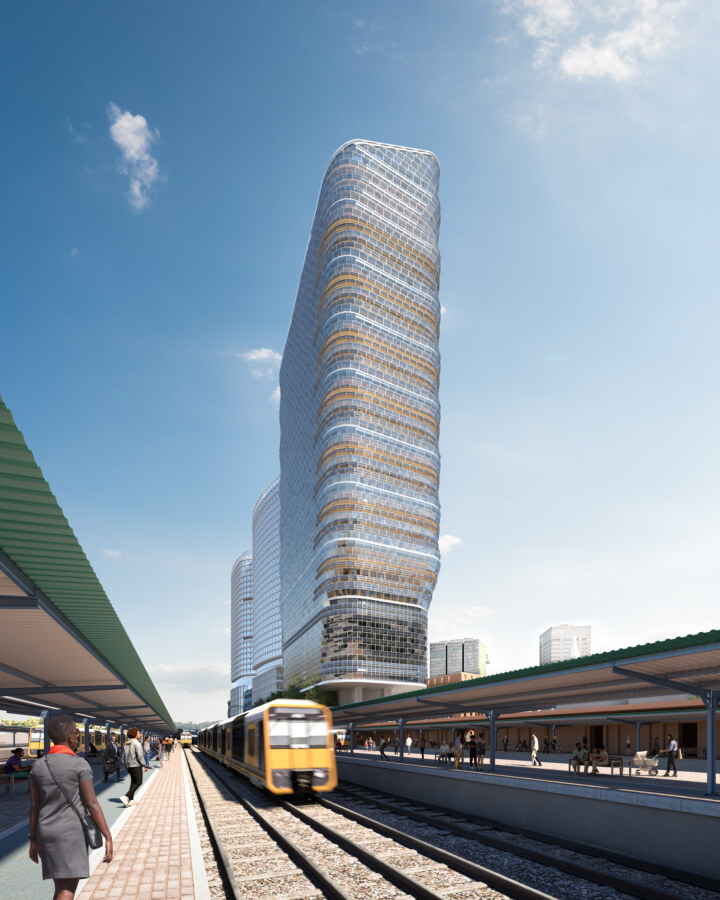
The tower’s hybrid timber megastructure is comprised of a concrete core and structural steel mega floors at every four levels with services threading through carefully engineered penetrations in both materials. The complexity demanded precision engineering, particularly for the prefabricated ladder frames that simultaneously support mechanical services and structural loads around the building core.
“The steel frames, resembling a spider web structure around the building’s central core, represent a groundbreaking approach to service integration,” says John Deimezis, Project Manager at A.G. Coombs. “Unlike typical prefabricated frames that serve only mechanical systems, these installations carry the structural load of timber floors while also housing ductwork, piping and electrical wiring as the vertical risers for the project.”
The collaborative design process with steel contractors required sophisticated lifting calculations, pre-engineering certification and precise installation sequencing to ensure structural integrity while accommodating mechanical and other services.
Additionally, commissioning procedures will require carefully-controlled humidity management to prevent timber movement and cracking by limiting air conditioning to approximately 5% humidity change per week during system start-up to avoid ‘thermal shock’ to the timber structure.
The building’s plant configuration created significant logistical and engineering challenges. Major mechanical equipment on Level six serves the building up to Level 34, with additional plant rooms at Level 39 near the building crown.
This arrangement, chosen to maximise net lettable area in mid-level floors, requires high-pressure piping systems and larger equipment than would traditionally be distributed across multiple plant rooms.
Some of the air handling units measuring approximately 7×7 metres required careful installation coordination, with chillers pre-loaded before concrete completion and other equipment requiring specialised lifting and installation sequences.
“A.G. Coombs utilised extensive prefabrication throughout the project, manufacturing components at our Melbourne Integrated Prefabrication Facility including almost 20 pump, heat exchanger and other equipment skids for the Level 6 plant room alone,” comments John.
“The collaborative ladder frame construction with local steel contractors is a very innovative approach to integrating structural and mechanical systems, and horizontal prefabricated elements reduced on-site installation time and complexity.”
The project’s complexity extends beyond Atlassian’s corporate spaces to include a 137-room YHA hybrid accommodation facility occupying Level 1 through Level 5, requiring separate mechanical systems designed for the hospitality application while sharing certain building infrastructure. This dual-occupancy arrangement demanded careful system segregation and independent control capabilities.
For the A.G. Coombs team, Atlassian Central represents more than technical achievement. It is a landmark project demonstrating the potential for innovative mechanical solutions in sustainable design.
“From day one, this project set out with highly ambitious design and sustainability goals so we had to engage innovative engineers who could work with the joint venture to help deliver on the client’s vision,” says Brad Ellis, Senior Services Manager from Built. “A.G. Coombs has been exceptional in their mechanical engineering design innovation and installation; including their ability to work closely and effectively collaborate with Built on this landmark project.”
This article originally appeared in BE – Building Efficiency 2025-2026 magazine.
Loading ratings...


April 1, 2026 in News
When the founders of the Presbyterian Ladies’ College (PLC) welcomed the first cohort of 60 students to their East Melbourne school in 1875, they co...

December 18, 2025 in News
A.G. Coombs is proud to announce that six of our team members have been recognised at the 2025 AMCA National Industry Excellence Awards, held in Melbo...

December 16, 2025 in News
With an extensive pedigree in healthcare facilities, A.G. Coombs delivers building services solutions that prioritise wellbeing and recovery. For the ...
December 15, 2025 in News
The National Fire Industry Association of Australia (NIFA) brought the Victorian Fire protection community together on the 27 November to celebrate th...