Sydney Metro Martin Place is one of eight new stations built as part of the multi-billion-dollar reimagining of Sydney’s public transport network.
Delivered by Macquarie Group for the NSW Government, the project includes the construction of a new Metro station integrated with commercial, retail and public spaces.
Levelling up
As mechanical services contractor for the underground Metro station,
A.G. Coombs also delivered mechanical services to 1 Elizabeth, the 39-storey commercial office building at 1 Elizabeth Street, which was completed in
June 2024.
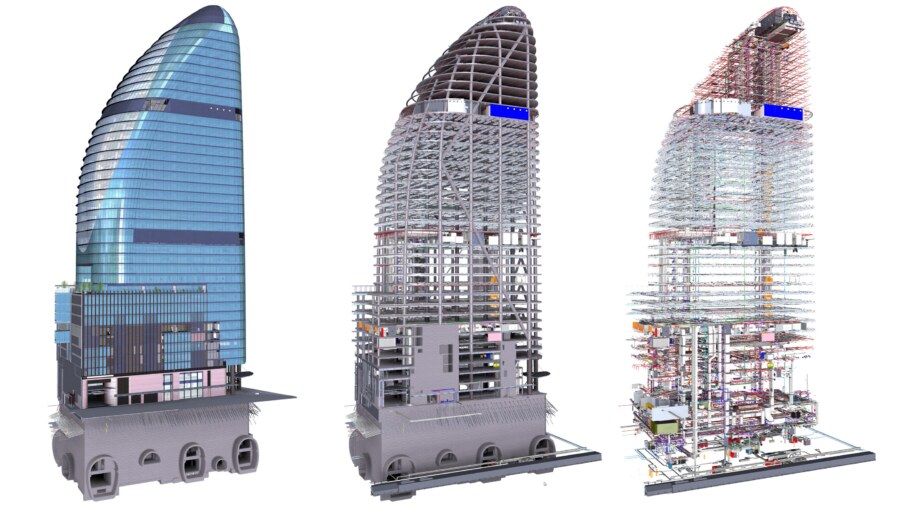
Located above the northern station entrance, the landmark JPW-designed building has a carefully-scaled alignment to the connecting heritage-listed
50 Martin Place building with large, stepping floorplates and a central open atrium providing natural light and ventilation. The integration of the two buildings forms Macquarie Group’s new global headquarters.
A.G. Coombs’ role included the delivery of base building mechanical services for Macquarie Group across 27 levels.
The fitout features a high efficiency mechanical services design incorporating passive chilled beams with underfloor displacement primary air and heat recovery systems.
Electric dreams
All plant serving the building is electric requiring the rooftop plantroom to accommodate a prefabricated heating hot water (HHW) plant consisting of
14 electric heat pumps. Consideration was also given to maintenance and lifecycle, with the building maintenance unit (BMU) altered to cater for the installation and future replacement of plant.
The heat pump plant and associated controls are designed in series and provide significant flexibility through their reverse cycle capability. Consequently, both heating hot water and chilled water (CHW) can be generated concurrently.
Infrastructure for this plant, including pipes, pumps, risers, coils and heat exchangers was also redesigned to suit the limited heat pump temperatures (up to 55˚C) that are lower than traditional gas-fired plant (˜80˚C).
According to A.G. Coombs Senior Engineer Morgan Smith, the complexities associated with this change were overcome through careful, considered design that took into account the operating delta T (temperatures) of the heat pump system.