BE: How did Circularity at A.G. Coombs Originate?
Andrew Nagarajah: The A.G. Coombs Circularity initiative was born out of our Leading Edge program, a professional development initiative that brings together teams of people from different parts of A.G. Coombs to deliver business improvement projects.
As part of our whole-of-life approach to all projects, we recognised that circularity is fundamentally important to us, our clients, and the industry.
The A.G. Coombs Circular™ concept centres on internal measures first and foremost so we can continually improve our approach to all projects and thrive in the circular economy.
BE: What does the A.G. Coombs Circular™ program look like in practice?
Andrew Nagarajah: The industry is moving towards a lifecycle approach in understanding the total emissions and environmental impacts of buildings.
The embodied carbon that goes into the mechanical, electrical, and other building services systems is a key part of this understanding.
Our first step involves looking inward to identify areas where we can continue upskilling our teams to think ‘circular’, and to provide informed advice on circularity to our clients.
A significant part of the initial phase is educating our people on what exactly the circular economy is, what it means for our industry, and what it means for our business.
We want to embed a circular mindset into every A.G. Coombs business and every service we provide to our clients.
BE: What parctical impact will your focus on circularity have on end clients and their assets?
Andrew Nagarajah: Legislation has already been introduced in one Australian State with a requirement to consider embodied carbon at a building project’s planning stage. We are also witnessing requirements in major building projects to incorporate circular principles in building services design. Coupled with this, the National Australian Built Environment Rating System (NABERS) is set to release its Embodied Carbon rating tool. This will enable new buildings and major refurbishments to measure, verify, and compare their upfront embodied carbon with similar buildings.
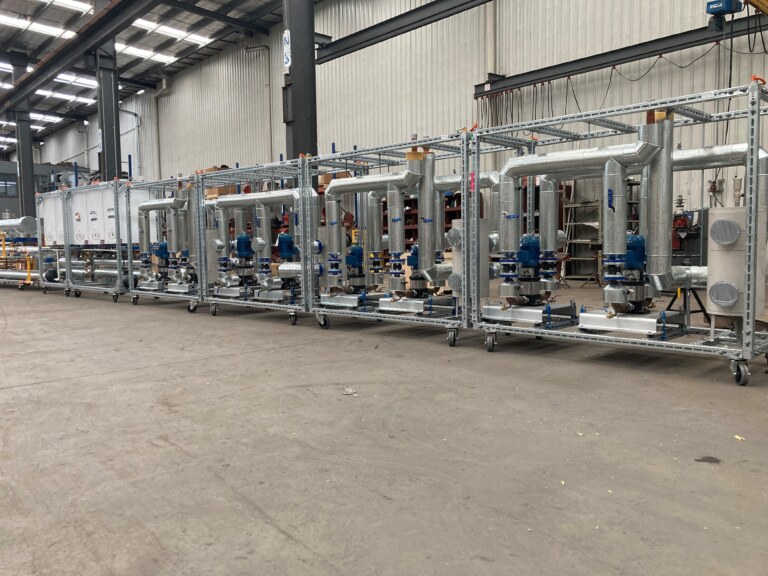
One practical way to embrace circularity is through a prefabrication ‘design for disassembly’ approach.
The A.G. Coombs integrated Prefabrication team can consider whether design and fabrication can allow for bolting components together instead of traditional welding. This allows for better disassembly and the increased probability that materials and equipment can be reused or repurposed at the end of their first application.
We’re also focused on reducing material wastage in our off-site fabrication processes. For example, assessing project requirements for elements such as the steel members used for services modules and developing a total
project-cutting regime that minimises offcuts, reducing the amount of steel that would otherwise be wasted in a traditional fabricate-on-site
‘stick-built’ approach.
BE: Does A.G. Coombs have industry linkages to help accelerate its circularity ambitions?
Andrew Nagarajah: We are represented in the Material and Embodied Carbon Leaders Alliance (MECLA), an Australian industry organisation with a focus on transforming the building and construction sector to reach net-zero emissions by reducing embodied carbon. We participate in the Building Services Working Group, specifically focused on building capacity in the sector through education, benchmarking, and demonstrating demand.
As a business, A.G. Coombs requests embodied carbon information from our supplier and subcontractor trade partners who provide us with products and materials.
We use the internationally-applicable Chartered Institution of Building Services Engineers (CIBSE) TM65 calculation methodology for embodied carbon in building services equipment and undertake calculations that allow us to account for the proportion of embodied carbon in a building that can be attributed to building services equipment.
This supports our teams in better understanding how we can minimise embodied carbon through design, system selection, procurement alternatives, fabrication techniques and the inclusion of repurposed materials.
BE: What are the plans for internal education of the Circular initiative?
Andrew Nagarajah: We’ve started with a series of internal workshops and webinars, explaining circular concepts and addressing common misconceptions. The concept of circularity clicks with our people when they realise that recycling is only a very small part of the circular economy.
BE: Where to from here: what are big picture aspirations?
Andrew Nagarajah: Our ambition as a business is to have full consideration of circular principles on every project. Internally we talk about the circular lens and we promote the idea that when you look at the business and our activities through a circular lens, you see things differently.


![The 10R Model ranks the circularity of various resource management strategies. It is ordered from most circular strategy at the top, down to the least circular. For example, the “Refuse” strategy - i.e. preventing raw materials’ use in the first place - is more effective in moving us to a circular economy than the “Recycle” strategy. [Source: Adapted from Cramer, J 2020, “How Network Governance Powers the Circular Economy: Ten Guiding Principles for Building a Circular Economy, Based on Dutch Experiences.”]](https://www.agcoombs.com.au/wp-content/uploads/2025/03/Levels-of-Circularity-Extract-BE-magazine-e1745369123180.png)