September 30, 2026 in Advisory Notes
Refrigerants – The Future is Here
It has been five years since we last published our Advisory Note titled The Future of Refrigerants. The future of refrigerants is no longer a future d...
March 21, 2023

The driver for electrification is not always the same for every building. For new buildings, it is an obvious choice to design and implement a system that does not rely on fossil fuels. However, for existing buildings the business case will vary.
The key benefits of electrification include:
The most common use of fossil fuel in buildings is natural gas used for firing heaters to produce hot water for space heating, and domestic hot water heating. This typically represents between 10% and 30% of a building’s Scope 1 and 2 greenhouse gas (GHG) emissions.
A number of buildings also rely on natural gas-powered cogeneration and tri-generation systems which provide on-site electricity generation and recover thermal energy to provide input to their heating and cooling systems. With the current emission factors used for NABERS ratings, these systems can currently provide an uplift to the building’s NABERS energy rating.
Other fossil fuels that generally represent less than 1% of a buildings GHG emissions include gas cooking in kitchens and diesel use for standby or backup generators. Refrigerants also need to be considered with any NABERs Carbon Neutral Rating, however these do not impact a NABERs Energy Rating.
Where businesses currently claim Net Zero Carbon, Carbon Neutral or Climate Positive, they are often enabling this via eligible carbon offsets. These carbon offsets should be viewed as a measure of last resort to offset the emissions produced throughout the operation of the building. Whilst carbon offsets are currently recognised by rating schemes to offset fossil fuel emissions, this is not expected to be a long-term situation.
At the time of writing, where the electricity grid relies mostly on coal fired power power stations, the use of natural gas for space heating and domestic hot water is generally considered to generate less emissions compared to an equivalent energy efficient electric heat pump system.
This is changing as the electricity grid decarbonises.
Grid decarbonisation relates to the decreasing of emissions per unit of electricity generated via the use of renewable energy sources and reduction in use of coal powered power stations throughout the Country.
Grid decarbonisation coupled with improvements in electric technology will mean that the extent of emissions required for electric retrofit options will be less than the gas powered equivalent. Electrifying already makes sense now where on-site renewable energy can offset any additional electrical power requirements or the grid is already operating on 100% renewable energy (e.g. ACT).
Electrifying space heating systems can be challenging where natural gas is to be removed from the building. Small buildings are less complex with smaller and sometimes decentralised systems, whilst medium to large buildings that rely on larger central gas-fired heating hot water systems can be complex.
The most commonly considered retrofit option is electric heat pumps which utilise the refrigerants vapour compression cycle to convert electrical input power to thermal energy. There are multiple heat pump options available in the market with significant technology advances over the recent years. Depending on the equipment capacity and building design, the following options are available that meet most buildings’ heating requirements:
The following key aspects should be considered when looking at replacing gas-fired water heaters with electric heat pumps:
For most existing buildings, the following items should be questioned now to future-proof the building when the plant is proposed to be electrified:
Electrifying domestic hot water (DHW) systems is becoming a much more common practice. Heat pump technology is the most common option ensuring the system can deliver above 60 deg.C water to satisfy Australian Standards where water is being stored.
Similar to the heating hot water systems, the following key items need to be considered:
Additional initiatives should also be reviewed as part of any domestic hot water retrofit project including the potential to resize the plant based on the connected fixtures and the ability to integrate initiatives such as solar PV or solar evacuated tubes to reduce the reliance on the electricity supply grid.
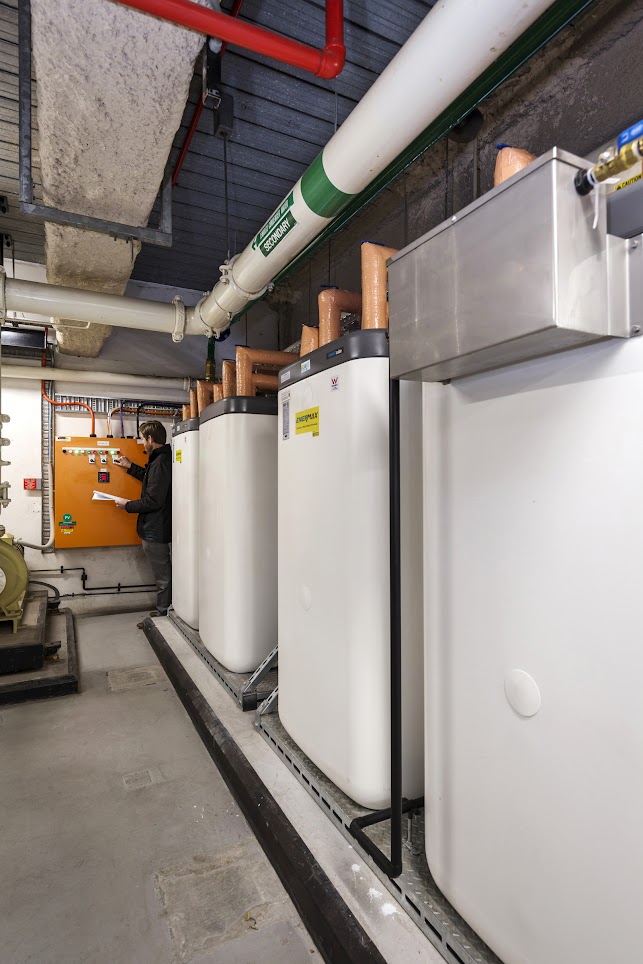
The other major fossil fuel systems in some larger commercial buildings are cogeneration and trigeneration systems. With increasing gas tariffs these systems are becoming less favourable financially and as the grid decarbonises, they will also become less favourable from an emissions and consequentially a building energy rating perspective.
Building owners should start to plan the decommissioning process for these systems taking into account the life cycle of the plant, rebuild costs, NABERS impact both short and long-term and whether additional heating or cooling plant is required to meet the buildings peak demands. If the trigeneration/cogeneration plant also provides standby power to the building, an alternative source of essential power should be considered.
Electrification of the diesel generators is likely to be a much longer-term solution as technology will evolve and we move away from diesel standby generators. Currently some options include biofuel generators and hydrogen fuel cells.
As standby generation systems are typically responsible for less than 1% of the buildings GHG emissions, these are considered lower priority in the larger scheme of building electrification.
What are the next steps involved to electrify your building? Each building needs to be assessed with regard to their specific retrofit options in order to remove the need for fossil-fuel consuming plant and equipment.
The following outlines the potential steps to prepared for building degasification and electrification:
For more information on degasification and electrification of buildings contact A.G. Coombs Advisory:
Jamie Park | Melbourne
T: +61 3 9248 2700 | E: jpark@agcoombs.com.au
Daniel De Valentin | Canberra
T: +61 2 6217 5600 | E: ddevalentin@agcoombs.com.au
Eoin Loughnane | Sydney
T: +61 2 9248 7400 | E: eloughnane@agcoombs.com.au
John Bourne | Brisbane
T: +61 7 3648 0500 | E: jbourne@agcoombs.com.au


September 30, 2026 in Advisory Notes
It has been five years since we last published our Advisory Note titled The Future of Refrigerants. The future of refrigerants is no longer a future d...

August 27, 2026 in Advisory Notes
External air quality degradation has emerged as a major operational concern for Australian buildings and the issue is expected to intensify as the cli...

July 20, 2026 in Advisory Notes
Building Management and Control Systems (BMCS) underpin the reliable and safe operation of commercial and institutional buildings. The technology cont...

May 26, 2026 in Advisory Notes
Australian Standard AS/NZS 4836:2023 was developed in response to identified risks to workers from electric shock and arc flash. It provides guidance ...